
• 858-771-9500
  • CAREERS
  • CLIENT LOGIN
Centura Wealth Advisory
  • Who We Are
    • Our Mission
    • Our Team
  • Our Approach
    • Our Process
    • Who We Help
    • Our Commitment
    • Professional Roster Optimization
  • Resources
    • Insights
    • Podcast
    • Advisor Learn Site
  • Contact Us
  • Menu Menu
INVESTING, NEWS

Capital Market Projections & Monte Carlo – Part 2 in series

Executive Summary

  • Capital Market projections (mean & variance) serve as parameters for Monte Carlo simulation
  • The Monte Carlo Method is used by Centura for Liberated Wealth planning in order to solve complex problems when other methods fail
  • Relying on historical data for Monte Carlo simulation may produce misleading results with potentially harmful ramifications (e.g., spending too much, retiring too soon, etc.)
  • Forward looking capital market projections incorporate structural market changes that are present today and/or are expected to continue in the future
  • Careful consideration of inputs and related assumptions is paramount when crafting long term financial plans and forecasting portfolio returns & risk; garbage in, garbage out

Introduction

Sophisticated projections are critical to crafting a well-designed financial plan and capital market projections are one of many key inputs that play a vital role in doing that. At Centura Wealth Advisory, we pair forward looking capital market projections with the Monte Carlo Method to estimate:

  1. Probability of a client running out of money before their “end of plan” (i.e., death)
  2. Most likely “end of plan” value (e.g., wealth transfer, charitable giving purposes)
  3. Optimal asset allocation strategy for a given plan

Part 1 of this series introduced capital markets, historical returns and forward-looking return/risk projections. In Part 2, we explore the Monte Carlo Method and evaluate the potential pitfalls of using historical results vs. forward looking projections when conducting experiments/simulations. Part 3 of the series will focus on portfolio construction and strategic asset allocation using mean variance analysis.   Readers can take our quick assessment survey provided at the end of this blog or found here. 

Monte Carlo Method

The Monte Carlo Method is a risk management tool that allows financial professionals to model and predict the future with varying levels of confidence. This tool is particularly valuable when it comes to retirement planning, which tasks advisors with forecasting a wide range of variables including, but not limited to:

  • Asset returns
  • Future income from all sources
  • Asset distributions (withdrawal rate) to support future income shortfalls
  • Taxes (based on current law and potential for sunset provision)
  • Varying inflation rates for different types of expenses (e.g., general vs healthcare)
  • Other volatile, subjective and potentially unknown factors as well

Problems of this nature are too complicated to solve with one formula, so we must employ an alternate approach.

Enter, the Monte Carlo Method. This method uses scenario modeling to predict a range of future possibilities, all with varying levels of probability (or likeliness to occur). At the upper end of the range are the very best scenarios (90th percentile), and at the lower end of the range lie the worst (10th percentile). At the midpoint of this range (50th percentile) lies the median which represents the most likely end of plan value (best estimate). If all scenarios end in assets at the end of plan above $1, the simulation is considered a success. If assets are exhausted prior to end of plan, it is a failure. The percentage of successful simulations represents the plan’s overall probability of success.

Monte Carlo Experiment: Hypothetical example

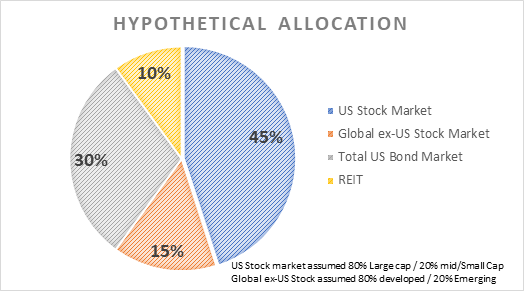
To illustrate how the Monte Carlo Method works, we will run a simple Monte Carlo simulation on a $1,000,000 portfolio invested as follows:

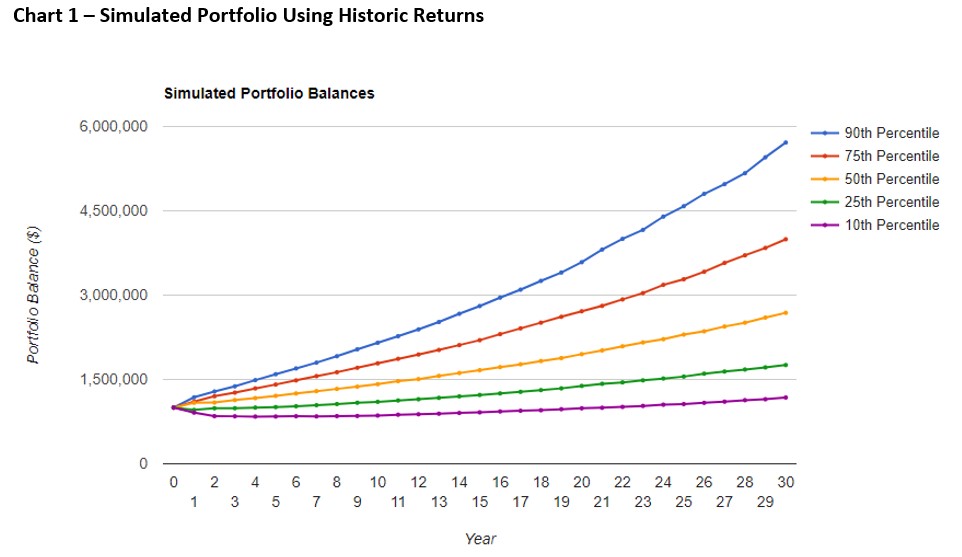
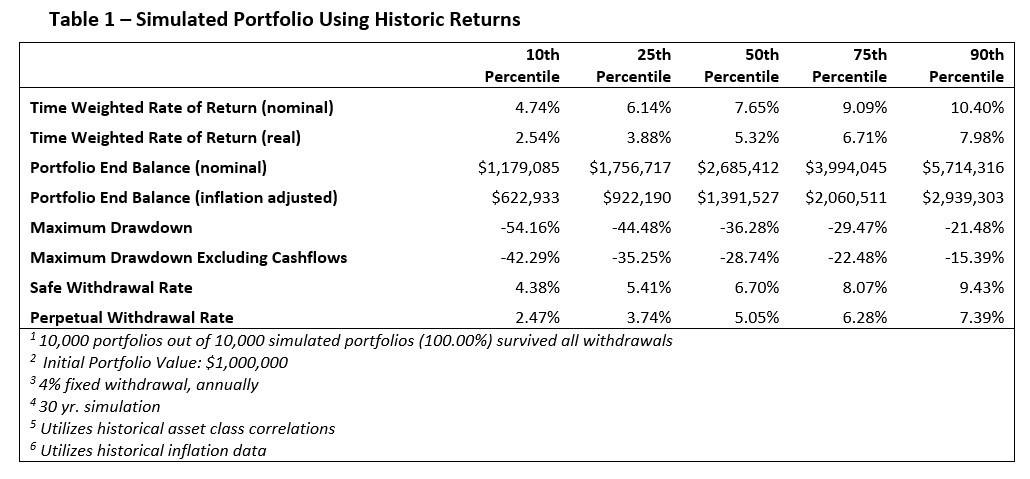
We will first conduct this simulation using historical returns & risk (Chart/Table 1) and then we will re-run the simulation using forward looking return & risk estimates (Chart/Table 2). Last, we will compare the results (Table 3) and highlight any key insights garnered.

Monte Carlo Experiment: Historical Returns

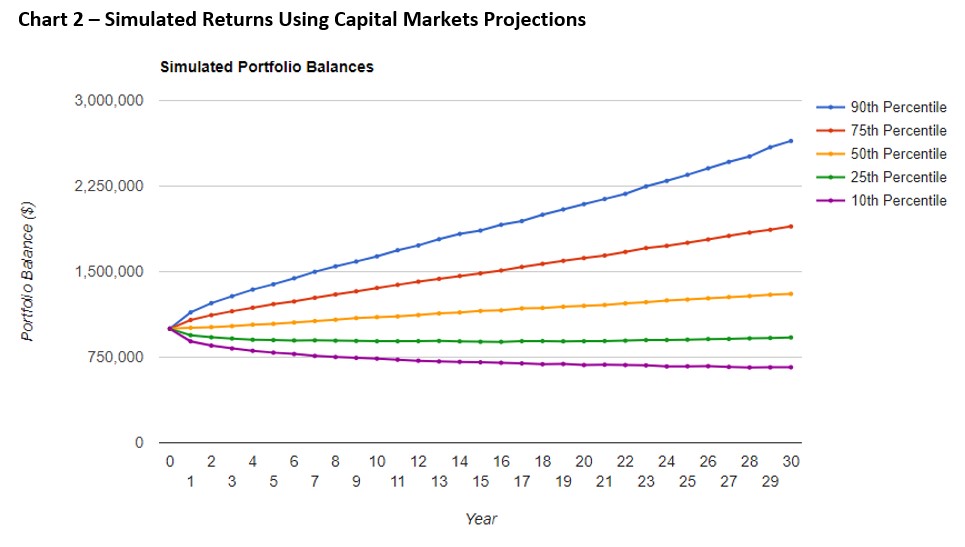
In Chart 1– Simulated Portfolio Using Historic Returns, we show a $1,000,000 portfolio simulation run 10,000 times based on historical asset class returns & risk. The different color lines indicate different percentiles of returns and summary statistics for each percentile can be found in Table 1.

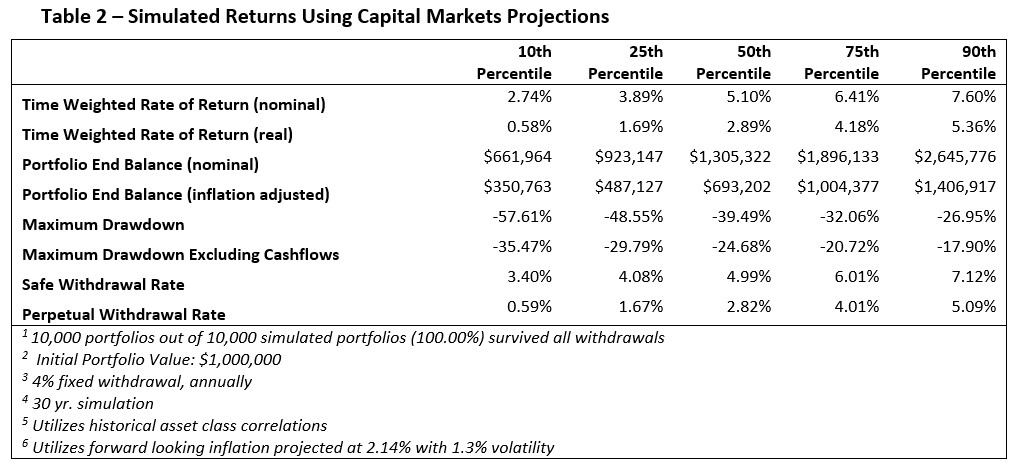
In Chart 2– Simulated Returns Using Capital Markets Projections, we show a $1,000,000 portfolio simulation run 10,000 times based on forward looking asset class returns & risk. The different color lines indicate different percentiles of returns and summary statistics for each percentile can be found in Table 2.

Monte Carlo Experiment: Comparing Results

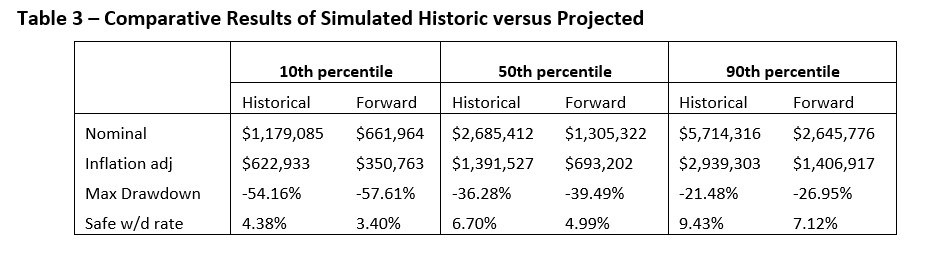
To analyze simulations using historical vs forward looking projections we will select the 10th percentile (worst) returns and 90th percentile (best) returns to compare the nominal and inflation adjusted ending portfolio values as well as maximum drawdown and the safe withdrawal rate; see Table 3 – Comparative Results of Simulated Historic versus Projected.

Comparing statistics in Table 3 reveals some key insights:

  1. Using historical returns may significantly overstate future portfolio values
  2. The portfolio’s safe withdrawal rate(s) may be overstated when using historical #’s
  3. Tail risk (max drawdown) is approximately equal, confirming that forward looking risk is commensurate with historical levels if not slightly higher (i.e., lower expected risk adjusted returns; see Part 1 of Capital Markets Blog)

These insights highlight some of the primary reasons why forward-looking capital market projections are preferred to historical numbers when modeling the risk that someone may run out of money before their “end of plan” (i.e., death). But why do they diverge? One of the primary reasons forward looking estimates diverge from historical results are due to what are known as “structural changes” or shifts.

Structural shifts are changes in the overall landscape of a market/economy, and if not handled properly, skew data. For example, a future riddled with tariffs and global tension is much different than the coordinated global easing (QE) that took place in the wake of the Great Recession. Similarly, the high interest rate environment of the 1980’s is materially different than the low interest rate environment of today, and not accounting for such structural components can produce misleading results; as evidenced above. Thus, investors and advisors must be careful when crafting plans and modeling long term risk.

Conclusion

Monte Carlo simulation is a complex, but effective risk management tool used by Centura that pairs asset forecasting with cash-flow modeling, over a long period of time and allows investors to evaluate the impact of different decisions on their long-term financial wellness.

Monte Carlo simulation usefulness is predicated upon the accuracy of input data whereby capital market return and risk forecasts represent the input parameters.  You can determine the status of your current Retirement Plan analysis by taking our quick survey here.

In Part 3 of this series, we explore how these same capital market projections are used to construct portfolios and form strategic long-term asset allocation plans using mean variance analysis and optimization.

Disclosures

Centura Wealth Advisory (“Centura”) is an SEC registered investment adviser located in San Diego, California.   This brochure is limited to the dissemination of general information pertaining to Centura’s investment advisory services.  The statistical projections contained herein are provided only as an example to illustrate how the choice of methodology impacts those projections.  Historical performance is no guarantee of future results and may have been impacted by market events and economic conditions that will not prevail in the future.   Investing involves risk, including risk of loss.   

Centura Wealth does not make any representations as to the accuracy, timeliness, suitability or completeness of any information prepared by any unaffiliated third party, whether linked to or incorporated herein.  All such information is provided solely for convenience purposes and all users thereof should be guided accordingly.

For additional information about Centura, please request our disclosure brochure as set forth on Form ADV using the contact information set forth herein, or refer to the Investment Adviser Public Disclosure web site (www.adviserinfo.sec.gov).   Please read the disclosure statement carefully before you engage our firm for advisory services.

05/31/19
https://centurawealth.com/wp-content/uploads/2024/08/simulation-small.png 3236 4821 Andre Lawrence https://centurawealth.com/wp-content/uploads/2024/07/Centura-Logo-White.png Andre Lawrence2019-05-31 16:35:002025-04-08 16:16:34Capital Market Projections & Monte Carlo – Part 2 in series
INVESTING, NEWS

Capital Market Projections

Executive Summary

  • Capital market projections (risk & return) allow Centura Wealth Advisory (CWA) to help clients with long-term strategic financial planning
  • Estimates are applicable to financial planning, portfolio construction and risk management
  • Represent the best thinking regarding forward looking markets and a longer-term outlook
  • Issued by many sources and different methodologies are employed
  • Financial planning risk models (e.g., Monte Carlo simulation) require such assumptions as inputs
  • Portfolio construction utilizes these projections to evaluate markets and make informed decisions around asset allocation and investments
  • Careful planning is recommended given current views on forward looking markets and the uncertainty represented therein

Introduction

Capital market return (and risk) projections are at the heart of wealth management.  These projections are a critical input to financial planning and portfolio management applications where the opportunity cost of mis-estimation is material: project too high and one may get a false sense of security out of their retirement plan and/or portfolio estimates; project too low and one may not provide a realistic estimate of the future, thereby making naïve decisions with potentially harmful results (e.g., working too long, saving too much, taking too much portfolio risk, etc.).

In part 1 of a 3-part series, we discuss capital market projections, provide a framework for creating current estimates and compare those estimates to historical results. In parts 2 and 3 of this series, we discuss how capital market projections are used in financial planning and portfolio construction (i.e., Monte Carlo simulation and mean/variance optimization) applications.

Capital Markets

Capital markets are venues where buyers and sellers engage in trade of financial securities. Examples include stock and bond markets where savings and investments are exchanged between the suppliers of capital and those who demand it.  Suppliers of capital include retail and institutional investors whereas those in need of capital are businesses, governments and people. 1,2,3

Capital markets consist of various types and sub-types. For example, stock markets can be broken down into large, mid and small company stocks as well as growth, value or blend.4 While there are many ways to slice and dice capital markets, below is a list of asset classes that are common among many of the providers and are also utilized in both financial planning and portfolio management applications at Centura:

Table 1 – Capital Market Asset Classes
EquitiesFixed IncomeAlternatives
Large Cap GrowthGovernmentReal Estate
Large Cap ValueMunicipalHedge Funds
Mid CapCorporatePrivate Equity
Small CapHigh YieldCommodities
International EquitiesInternational 
Emerging MarketsCash

Each asset class has its own drivers of both risk and returns and must be evaluated differently when measuring and predicting both risk and returns. In addition, different firms and analysts within those firms may have different methods of evaluating each asset class and that means a wide variety of methodologies are employed.

To illustrate how firms may vary, here is an example of how Invesco estimates asset class returns which differs slightly from the approach used at the Callan Institute. We won’t dive into the specifics of different methods employed, but one should understand that differences exist between firms and careful consideration should be paid as to which estimates are utilized, when and why.

Capital Market Returns: Historical Results

Now that we understand different capital markets and their related asset classes, we can evaluate historical data to see how various asset classes have performed over time:

Table 2- Asset Class Historical Results
Asset ClassIndexAnnualized* Return (10yr)Annualized* Return (25yr)
Large CapS&P 50013.12%9.07%
Mid/Small CapRussell 250013.15%9.62%
International EquitiesMSCI World ex USA6.24%4.76%
Emerging MarketsMSCI Emerging Mkts8.02%7.9%1
US Fixed IncomeBarclays Aggregate3.48%5.09%
Non-US Fixed IncomeBarclays Global Agg ex-USA1.73%4.39%
Cash90-day T-Bill0.37%2.55%
Hedge FundsCallan Hedge FOF5.26%6.06%
CommoditiesBloomberg Commodity-3.78%2.03%
Private EquityCambridge PE11.62%15.46%
Real EstateNFI-ODCE6.01%8.05%
Annualized returns for periods ended 12/31/2018.  1 Denotes 15 yr annualized return as 25 yr data is not availableSource: Callan Institute

Historical returns are the baseline for which forward looking projections can be evaluated against and contextualized upon.  While historical returns are insightful and provide context for both planning and portfolio management applications, they may have little or nothing to do with what is expected to take place in the near, intermediate and/or long term. To highlight this point, we note the well-known industry disclaimer which states, “past performance is not indicative of future results”. So, to cover our bases and provide a more robust view, we will now look at forward looking return projections followed by a comparison between the past and present.

Capital Market Return & Risk:  Forward looking projections

To predict the future, however futile that may be, many institutions provide capital market projections that provide practitioners (and interested readers) with their firms best thinking regarding forward looking markets and long-term outlooks. These estimates serve as inputs for a variety of applications including Monte Carlo simulation and portfolio construction using mean variance optimization, both of which are key considerations to a healthy and sustainable long-term financial plan.  

A partial but influential list of firms that provide capital market forecasts include:

  1. Callan Institute
  2. JP Morgan
  3. Blackrock
  4. Bank of New York
  5. MFS
  6. RBC
  7. PIMCO
  8. Goldman Sachs

While any single provider can be utilized, each brings a different methodology to the table and an average of several providers can be a good way to obtain exposure to many firms’ best ideas and to reduce risk associated with any one firms’ method being off in any given year.  

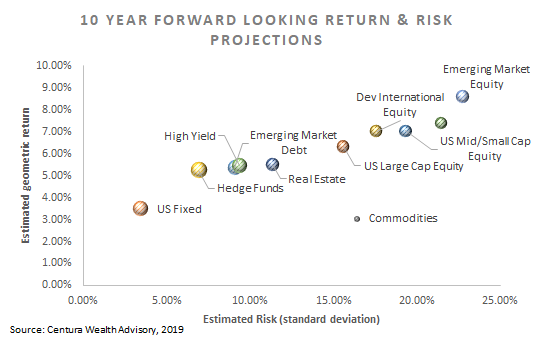
The Table 3 below shows different asset classes and the 10 year forward looking estimates, averaged amongst several providers included in the list above. Table 3 also shows the estimated Sharpe ratio (i.e., risk adjusted return) which allows for an apples-to-apples comparison of asset classes, controlling for risk.  Furthermore, we also include the real return, which is gross return less inflation (estimated to be 2.14% over the same period). In Chart 1 we represent these same results visually.

Table 3 – Forward Looking Estimates
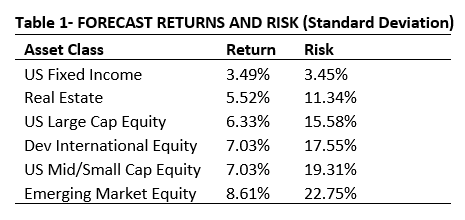
Asset ClassReturnRiskSharpe RatioReal Return
Cash Equivalents2.20% 0.48%0.000.06%
US Fixed              3.49%3.45%0.371.35%
Non-US Fixed1.95%6.57%-0.04-0.19%
Hedge Funds5.25% 6.91%0.443.11%
Emerging Market Debt 5.37% 9.08%0.353.23%
High Yield               5.47%9.35%0.353.33%
Real Estate5.52%11.34%0.293.38%
US Large Cap Equity6.33%15.58%0.274.19%
Commodities           3.04%16.40%0.050.90%
Dev International Equity    7.03%17.55%0.27 4.89%
US Mid/Small Cap Equity    7.03%19.31%0.254.89%
Private Equity    7.41%  21.45%0.24 5.28%
Emerging Market Equity    8.61% 22.75%0.286.47%
Note: inflation estimate is 2.14% annualized.  Sources:  Callan Institute, JP Morgan, Blackrock, Bank of New York, MFS, RBC 

Chart 1

What is notable about the returns in Table 3, is that while asset class trends may be the same (e.g., stocks > bonds > cash) domestic equity returns are significantly lower than the returns in Table 2 as are private equity and real estate (over both time periods).  This means that firms expect future returns in these asset classes to be less than historical results, which is in line with the big picture takeaways garnered from analysis of the current Shiller P/E ratio (as well as the current Buffett Indicator), both of which seek to estimate forward returns by incorporating capital market and economic data such as stock prices, GDP and earnings cyclicality. However, volatility in these asset classes is expected to stay in line with historical levels (if not slightly higher) which implies that investors should expect lower returns for the same level of risk on a go forward basis.

These lower forward-looking return projections are due to the cyclical aspect of business, credit and the economy. In the United States, we are late in the economic expansion cycle(s) and most expect some negative years (i.e., economic slowdown) in the coming decade which would materially impact return figures as compared to a decade prior when economic expansion was predominate.  

This does not necessarily mean doom and gloom ahead but does imply that caution should be heeded in terms of where risk assets are allocated. Perhaps a greater allocation to cash and other stable investments is warranted given the relatively low level of anticipated inflation. However, if real returns on cash go markedly below zero, investors will be incentivized to purchase risk assets (e.g., stocks & bonds) at even more elevated prices than today, meaning the opportunity cost of sitting in cash is high. With such a dichotomy, careful planning is certainly required.

Conclusion

Individuals looking to retire (i.e., access investment assets for income) in the next 15 years would be well served to review their investment allocations and future income/cash-flow plans in the wake of a decade worth of gains in most risk assets. For these investors, locking in gains and preserving capital is of paramount importance, but in markets such as these professional guidance will certainly help navigate choppy waters.

Additionally, for investors already in retirement drawing down investment assets, extreme caution must be paid to asset distribution plans and how those assets are invested. Sequence risk can exacerbate financial plan failures and in order to protect against running out of money in adverse scenarios, sophisticated planning software and risk models must be employed to develop a robust cash-flow and integrated portfolio plan that is well suited to defend wealth in any and all markets.

In part 2 of this 3-part series, we will explore risk modeling in financial planning (e.g., Monte Carlo simulation). Last, part 3 will explore how capital market projections are used to construct portfolios and develop strategic asset allocations.

About the Author

Sean Clark holds a Master of Science in Risk Management from New York University and a Bachelor of Arts in Economics from Clemson University. Areas of practice include financial planning and portfolio management, specializing in applied mathematics and risk.

References

  1. https://www.investopedia.com/terms/c/capitalmarkets.asp
  2. https://www.investopedia.com/ask/answers/021615/whats-difference-between-capital-market-and-stock-market.asp
  3. https://economictimes.indiatimes.com/definition/capital-market
  4. Why does portfolio construction matter – PIMCO
  5. Callan Institute
  6. JP Morgan
  7. Blackrock
  8. Bank of New York
  9. MFS
  10. RBC 
  11. PIMCO
  12. GoldmanSachs
  13. RightCapital
  14. XY Planning Network
  15. Invesco
  16. Multipl
  17. Gurufocus
  18. Yale.edu
  19. The balance
Disclosures
Centura Wealth Advisory (“Centura”) is an SEC registered investment adviser located in San Diego, California.  This brochure is limited to the dissemination of general information pertaining to Centura’s investment advisory services.  Investing involves risk, including risk of loss. 
Centura Wealth does not make any representations as to the accuracy, timeliness, suitability or completeness of any information prepared by any unaffiliated third party, whether linked to or incorporated herein.  All such information is provided solely for convenience purposes and all users thereof should be guided accordingly.
Past performance is no guarantee of future results and may have been impacted by market events and economic conditions that will not prevail in the future. This newsletter contains certain forward‐looking statements (which may be signaled by words such as “believe,” “expect” or “anticipate”) which indicate future possibilities. Due to known and unknown risks, other uncertainties and factors, actual results may differ materially from the expectations portrayed in such forward‐looking statements. As such, there is no guarantee that the views and opinions expressed in this letter will come to pass.
Indices are unmanaged. Any reference to a market index is included for illustrative purposes only as it is not possible to directly invest in an index. The figures for each index reflect the reinvestment of dividends, as applicable, but do not reflect the deduction of any fees or expenses, or the deduction of an investment management fee, the incurrence of which would reduce returns. It should not be assumed that your account performance or the volatility of any securities held in your account will correspond directly to any comparative benchmark index. Bonds and fixed income investing involves interest rate risk. When interest rates rise, bond prices generally fall.
For additional information about Centura, please request our disclosure brochure as set forth on Form ADV using the contact information set forth herein, or refer to the Investment Adviser Public Disclosure web site (www.adviserinfo.sec.gov).   Please read the disclosure statement carefully before you engage our firm for advisory services.

05/08/19
https://centurawealth.com/wp-content/uploads/2024/08/Lead-Image.png 348 675 Andre Lawrence https://centurawealth.com/wp-content/uploads/2024/07/Centura-Logo-White.png Andre Lawrence2019-05-08 16:25:002025-07-06 21:27:14Capital Market Projections
Page 6 of 6«‹456

SEARCH

INSIGHTS

  • Close up of businessman using digital tablet with calendar planner and organizer to plan and reminder daily appointment, meeting agenda, schedule, timetable, and management, event planning
    Q4 2025 Market Wrap: The Year of Transition: Navigating the Intersection of Policy, AI, and Private Markets
  • Annual review, business, customer review. Action plan, review evaluation time for review inspection assessment auditing. Learning, improvement, planning and development. End of year business concept.
    Market Month in Review – November 2025
  • Annual review, business, customer review. Action plan, review evaluation time for review inspection assessment auditing. Learning, improvement, planning and development. End of year business concept.
    Market Month in Review – October 2025
  • Close up of businessman using digital tablet with calendar planner and organizer to plan and reminder daily appointment, meeting agenda, schedule, timetable, and management, event planning
    Q3 2025 Market Wrap: A Balancing Act

Connect with us

  • Facebook
  • Instagram
  • LinkedIn
  • YouTube

Ready to get started? Let's talk.

  • Link to Facebook
  • Link to X
  • Link to LinkedIn
  • Link to Instagram
  • Link to Youtube

SAN DIEGO

12255 El Camino Real, Suite 125
San Diego, CA 92130
GET DIRECTIONS
858-771-9500

MURRIETA

25109 Jefferson Ave, Suite 205
Murrieta, CA 92562
GET DIRECTIONS
951-677-3960

Our planning fee pricing for income tax planning services is determined using a standardized matrix based on Net Worth, Income, and Meeting Frequency. This base planning fee price may be adjusted to account for increased complexity or the occurrence of a future income event. To project tax savings, we analyze prior year tax returns to determine their past tax liability to project out the following year’s tax liability. Based on facts collected and confirmed by the client, we then identify and evaluate applicable tax strategies and the estimated annual tax savings they would produce if implemented. The estimated annual tax savings are then divided by the annual engagement price proposed to/agreed to by the client to determine the multiple on estimated annual tax savings generated as it relates to the planning fees paid. Please note, these initial projections are preliminary and based on our current understanding of the client’s situation. Outcomes may vary based on client’s decisions or chosen course of action regarding the implementation of recommended strategies, their specific goals, and risk tolerance.

LEGAL     PRIVACY POLICY     CAREERS     DISCLOSURES     FORM CRS


© 2025 Centura Wealth Advisory. The Centura Wealth Advisory logo is a trademark.

CCG Wealth Management LLC (“Centura”) is a Registered Investment Adviser. Advisory services are only offered to clients or prospective clients where Centura and its representatives are properly licensed or exempt from licensure. For more information click here

Scroll to top